
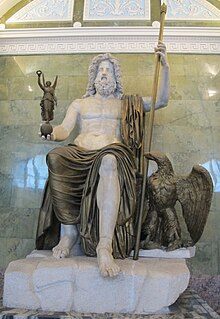

Chief deity in the Greek Pantheon between the 12 Olympian gods. God of the Sky, the Thunderer.
Zeus — known as Jupiter in Roman mythology — is the supreme ruler of Greek mythology. From the heights of Mount Olympus, he governs both gods and humans, embodying authority, leadership, and power. While immensely influential, Zeus is not omnipotent; rather than constant direct intervention, he often exercises control from a distance, reinforcing hierarchy and order.
Mythological Context
Zeus is the youngest son of Cronus and Rhea. To prevent a prophecy that one of his children would overthrow him, Cronus swallowed each newborn — except Zeus, who was hidden by Rhea. Zeus later returned, led a successful rebellion against the Titans, and claimed dominion over the sky.
His reign is marked by alliances, authority, and numerous relationships with goddesses and mortal women, producing many offspring. These unions strengthened his influence and extended his legacy throughout mythology — a key theme of the Zeus archetype.
In astrology, Jupiter is one of the most significant planets in the natal chart. Visible to the naked eye, it was known and revered by ancient astronomers and astrologers. Jupiter symbolizes expansion, opportunity, faith, and growth.
There is also an asteroid named Zeus (5731), discovered in 1988. When both a planet and an asteroid share the same archetypal name, astrologers distinguish their meaning:
- Jupiter represents the higher, expansive, constructive expression of the archetype
- Asteroid Zeus reflects the human, shadow, and ego-driven expression
The asteroid is considered only when it is strongly placed or prominently activated in the chart.
Jupiter (Zeus) in astrology
Jupiter is the largest planet in the solar system. Being the largest planet we associate expansion, growth with it.
Jupiter represents in the natal chart:
- Lucky chance, business opportunities: we feel we are lucky in that area of life in which house our Jupiter is.
- Wealth, security, expansion
- Higher learning, influencing, philosophical believes
- Wisdom, seeing the big picture while not getting lost in the details
- Faith in the future
Asteroid Zeus:
- The seducer, the cheeky one – usually with a prominent Zeus the individual has a lot of lovers, maybe more marriages. It doesn’t mean that the person is a good lover. He enjoys more of the part of concurring the woman rather wooing her after he feels he reached his goal.
- Arrogance – he can be strong headed and thinking that only his ways are working. He forces his will to his environment. Let it be within the family, at work or at his own business.
- Rigid: he doesn’t want to change the status quo.
- The person who is craving power and willing to get it. Even if he has to overstep other people to achieve his goal
Zeus archetype in psychology
- The king, the ruler: this archetype is a natural leader due to his ambitions and talent. He is inspired by the power above his own territory, let that territory be only a family, a business or a country.
- Determined/ definite moves: he has very good view on the big picture but still the small details are not neglected by him. When he wants to get something he focuses on it and without missing a beat he gets it even at the cost of ruining other people
- Master of alliances (both through business and through marriages): he is very much capable to work together with other powerful men. He is excelling at summits, agreeing alliances, and setting boundaries as well as negotiating alliances that is beneficial for each party. He expects from the others to participate in the negotiations pursuing their own well understood interest and he acts exactly like that. For him marriage is more an alliance that helps him build his empire than an act of love.
- The charmer / seducer: once he decides who he would like to get he will do everything to get close to the woman in question.
- The “father” in the sky: he has strong desire to have kids as he sees them the continuation of his empire. He is a mentor type of father, but he expects that the children acts according to his will.
How Zeus comes out in every day life in different life stages
Childhood and Early Years
A Zeus child reveals himself very early. He is strong-willed, decisive, and determined to assert control over his environment. This is the child who says “no” instinctively—not as rebellion, but as a declaration of autonomy. He wants to test limits, establish authority, and experience himself as the one who decides.
From a young age, he begins to build his own miniature world in which he is the leader. Power dynamics matter to him, and he instinctively seeks situations where he can exercise influence. The most effective way to guide a Zeus child is not through force, but by offering structured choices—allowing him to feel in control while still operating within boundaries.
Adolescence and Young Adulthood
As a teenager, the Zeus archetype naturally gravitates toward leadership roles. He is often the captain of a sports team, the center of a social group, or surrounded by loyal followers who form his “court.” Popularity and hierarchy become important, and he tends to associate with those who reinforce his status.
Romantic relationships are often approached as conquests rather than emotional connections. He seeks partners who enhance his image and position. During this stage, Zeus begins to understand hierarchy more consciously—accepting the world as it is, while simultaneously plotting how to secure his place at the top.
Adulthood and Professional Life
In the workplace, Zeus rarely sees himself as subordinate for long. He quickly believes he could perform better than those above him and instinctively analyzes systems, structures, and strategies. Leadership comes naturally to him, and he does not require instruction on how to take charge, work hard, or identify opportunities.
He is emotionally detached in professional settings and expects the same from others, which can make him appear cold or authoritarian. He is not easily distracted by personal matters and views work as a means to build his empire—whether that is a business, a leadership position, or a legacy within an organization.
Everything in his life becomes subordinate to this long-term goal. Marriage, when it occurs, is often approached as a strategic alliance rather than a romantic bond. It serves a purpose in supporting his ambitions rather than fulfilling emotional needs.
Family and Fatherhood
Zeus desires children as an extension of his legacy. He sees them as the continuation of what he has built. As a father, he often takes on a mentoring role rather than an emotionally nurturing one. He teaches through expectation, discipline, and example.
However, he expects obedience and alignment with his values. The family system operates according to his rules, and emotional closeness may be limited. Children raised under a dominant Zeus father often experience structure, security, and guidance—but may also perceive emotional distance and rigidity.




Leave a Reply