
![The Poseidon [Neptune] archetype: God of the sea](https://crystalclearbyreka.blog/wp-content/uploads/2026/01/king-neptune-ocean-poseidon-statue-1198963-scaled.jpg)


In this series, I explore the feminine archetypes through mythology, astrology, and psychology.
Each goddess represents a different energetic pattern within the female psyche.
In this article, we step into the world of Aphrodite — the archetype of love, sensuality, creativity, and magnetic presence.
Greek mythology
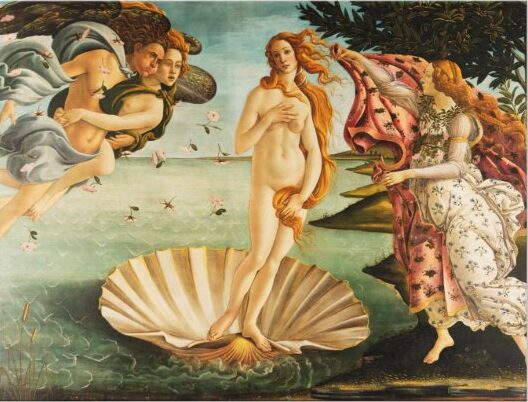
Aphrodite is one of the twelve Olympians, but according to the most widely accepted myth, she was born well before Zeus and his siblings. Zeus and the other Olympians were the children of Rhea and Cronos, while Aphrodite was born when Cronos castrated Uranus. This means she is far more ancient than the other Olympian gods and goddesses.
She married Hephaestus, yet she was unfaithful to him and had many lovers. In most Greek myths, various goddesses, nymphs, and human women are constantly threatened, pursued, or violated by male gods. Aphrodite is different: no one forces her, and she is free to decide for herself. This is why she represents a “carefree” woman who is adored by everyone and able to achieve anything through her personal charm.
Aphrodite’s Roman counterpart is Venus. There is a slight difference between the two goddesses. Venus is a creator and life-giver — beautiful and fruitful. Aphrodite, however, is often described as beautiful for her own sake.
There are two celestial objects connected with this archetype: the planet Venus and the asteroid Aphrodite.
Venus is the second planet from the Sun. Interestingly, it rotates in the opposite direction to most planets. It is the second-brightest object in the night sky. It is also one of the seven visible planets that ancient astronomers and astrologers could observe at the beginning of these sciences.
Astronomers discovered Aphrodite (asteroid 1388) in 1935.
Venus in astrology represents:
- Beauty, femininity, flirting
- Harmony and peace of mind — its function is always to strive for harmony
- In a male chart, it shows the ideal female; in a female chart, it reflects the erotic side
- Money and our relationship with money
- Art, music, dance, poetry, and harmony of colors
- Its house position shows where we strive for harmony
- How we express our emotions toward the opposite sex
Psychological expressions of the Aphrodite archetype
While mythology gives us her story, psychology reveals how this archetype operates within the modern woman.
The alchemical goddess — in her book Goddesses in Everywoman, Jean Shinoda Bolen places Aphrodite in a completely separate category from the other goddesses.
“Aphrodite seeks to consummate relationships and generate new life. This archetype may be expressed through physical intercourse or through a creative process.”
She is independent and able to focus on what is personally meaningful to her; others cannot easily divert her from her goal.
When Aphrodite is the dominant archetype in a woman’s personality, she falls in love often and easily.
Our culture degrades sensuality and sexuality in women. The woman who embodies Aphrodite the lover may be considered a temptress or a “whore.” Thus, this archetype, when expressed, can put a woman at odds with prevailing moral standards.
When two people fall in love, each sees the other in a special, enhancing (Aphrodite-golden) light and is drawn to the other’s beauty. There is magic in the air — a state of enchantment or infatuation. Each feels beautiful, special, more godlike or goddess-like than in their ordinary selves. The emotional field between them becomes charged, and erotic “electricity” is generated, creating mutual magnetic attraction.
However, when love is not returned, the experience changes dramatically. A woman may feel possessed by cruel desire and unmet longing. She is repeatedly drawn to the beloved and repeatedly rejected. The intensity — wonderful when love is mutual — now amplifies the pain instead.
Procreative:
Aphrodite represents the drive to ensure the continuation of the species. The archetype connected with the sex drive and the power of passion. She can turn a woman into a vessel of procreation. An Aphrodite-influenced woman may have a child out of her desire for a man or her longing for a sexual or romantic experience.
Creativity:
Aphrodite is a tremendous force for change. The creative product may be as abstract as the inspired union of two ideas that eventually give birth to a new theory. Creative work emerges from intense and passionate involvement — almost as if with a lover — as the artist interacts with the “other” to bring something new into being.
Cultivating:
Aphrodite is the archetype most connected to sensual or sensory experience. Therefore, cultivating keen perception and a present-moment focus invites Aphrodite’s energy.
Charisma: The Aphrodite archetype creates personal charisma — a magnetism or electricity — which, combined with physical attributes, makes a woman “an Aphrodite.”
How the Aphrodite archetype manifests across life stages
Childhood and early years
As a child, the little Aphrodite may have been an innocent flirt.
She enjoys being the center of attention, likes wearing pretty clothes. She is usually not shy she has her spontaneous performances, and attention-seeking behavior.
By the age of eight, many Aphrodite girls are eager to grow up, dress up, and wear makeup. They develop crushes on boys. Some young Aphrodites are “nymphets” — precociously aware of their sexuality and enjoying the sense of power and attraction they feel when older men respond to their flirtation.
Adolescence and young adulthood
Adolescence and young adulthood are crucial periods for the Aphrodite woman. She may find herself caught between the stirrings of Aphrodite within her and the reactions of others.
Given the double standard, a high school girl whose desire for sexual experience is as strong as that of a young man must carefully weigh the consequences.
When an Aphrodite woman goes to college, social aspects are often more important to her than academics. She may choose a “party school” — a college known more for social life than for rigorous studies.
She is usually not focused on long-term academic goals or career planning. Her interest in a professional path may fade when faced with difficult prerequisites that do not inspire her. However, she can immerse herself fully in her studies if she becomes fascinated with a subject — most often in a creative field involving interaction with people.
Adulthood and Professional Life
Work that does not engage her emotionally holds little interest for an Aphrodite woman. She prefers variety and intensity; repetitive tasks such as housework, clerical duties bore her. She performs best when she can be creatively absorbed, she almost always prefers a job she finds interesting over one that pays better but lacks appeal.
Aphrodite women often gravitate toward men who are not necessarily good for them. Unless other archetypes influence her, her choice of partners may resemble Aphrodite’s own lovers — creative, complex, moody, or emotional men such as Hephaestus, Ares, or Hermes.
If Aphrodite is one of several strong archetypes — including Hera — her presence can enhance and vitalize marriage with sexuality and passion.
However, a lifelong monogamous marriage may be difficult for an Aphrodite woman. Unless other archetypal influences help contain her within the marriage, or the partnership is especially harmonious, she may follow a pattern of serial relationships.
Aphrodite women generally love children, and children are drawn to them. A child senses that this woman looks at them with a nonjudgmental and appreciative gaze.
She brings out a child’s feelings and abilities in a way that makes the child feel beautiful and accepted. Often, she instills a sense of specialness that builds confidence and supports the development of talents.
The children of Aphrodite women thrive and develop individuality — especially if Demeter qualities are also present.
The inevitability of aging can be a devastating reality for an Aphrodite woman if her attractiveness has been her primary source of gratification.
At midlife, she may also become dissatisfied with her choice of partners. She may recognize a pattern of attraction to unconventional or unsuitable men and begin to long for stability — something she may previously have rejected.
However, middle age is thriving period for Aphrodite women if she produces creative work.
Aphrodite is not merely the goddess of beauty — she is the archetype of aliveness.
When integrated consciously, she becomes a source of creativity, magnetism, and emotional depth.
When unconscious, she can lead to chaos, heartbreak, and instability.
The question is not whether Aphrodite lives within us — but how consciously we choose to embody her.









Leave a Reply